Why does quick bread have long tunnels in it?
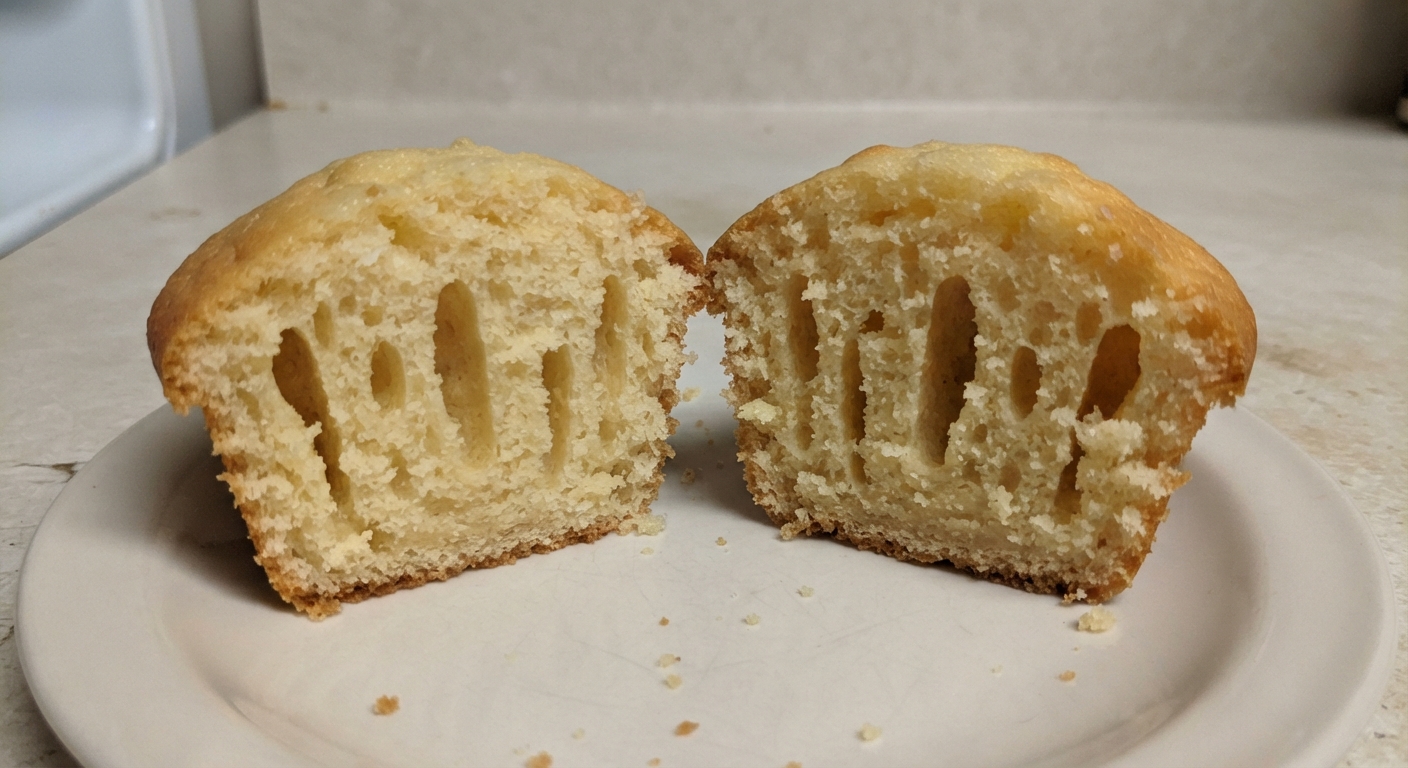
Those elongated holes in an overmixed muffin aren't random -- they're gas literally digging an escape route through gluten that the recipe never wanted developed in the first place.
The kitchen answer
Mixing quick bread batter more than needed develops gluten it wasn't designed to have -- and once leavening gas starts forming, it pushes through that unwanted gluten network along the path of least resistance, carving long tunnels instead of staying as small, even bubbles.
What's actually happening
Quick breads (muffins, banana bread, biscuits) rely on baking powder or soda for lift, not on a well-developed gluten network -- the recipe usually calls for mixing "just until combined" specifically to keep gluten minimal. Overmixing develops that gluten anyway, creating stretchy strands running through the batter.
Once CO₂ starts forming (which, for baking soda, begins the moment it's wet), the gas has to go somewhere. In a properly mixed batter with minimal gluten, it spreads into many small, evenly distributed bubbles. In an overmixed batter, the gluten strands act like tunnels of least resistance -- gas travels along them rather than staying put, leaving visible elongated holes once the crumb sets.
What does that mean for your recipe
"Mix until just combined, some lumps are fine" is a direct, practical instruction about gluten development, not a vague preference -- a few visible lumps of unmixed flour cost nothing, while the extra thirty seconds of mixing to eliminate them can cost you the whole crumb structure.
What can go wrong
- Tunnels appearing despite "correct" leavening amounts: a mixing problem, not a leavening quantity problem -- more or less baking powder won't fix it.
- Chasing a perfectly smooth batter: smoothness and correct mixing aren't the same goal for quick breads the way they might be for other batters.
- Using a stand mixer on a quick bread recipe: much easier to overmix past the intended point than by hand, since it's faster and less obvious when to stop.
- Tough, chewy quick bread alongside the tunnels: the same overmixing cause, showing up as a texture problem as well as a structural one.
Try it yourself
Same muffin batter, two mixing amounts:
- Mix one batch of muffin batter just until the flour disappears, lumps and all.
- Mix an identical batch for an extra minute, until it looks smooth.
- Bake both side by side and cut them open.
Watch for: the minimally mixed batch showing a fine, even crumb, while the overmixed one shows visible tunnels and a noticeably chewier texture -- from the same batter, same leavening, same oven.
Go deeper
This is the same gas-versus-structure relationship covered in why a cake rises and then collapses, just showing up as a texture defect instead of a structural failure -- here the structure isn't too weak or too slow, it's simply present where it wasn't supposed to be at all.